

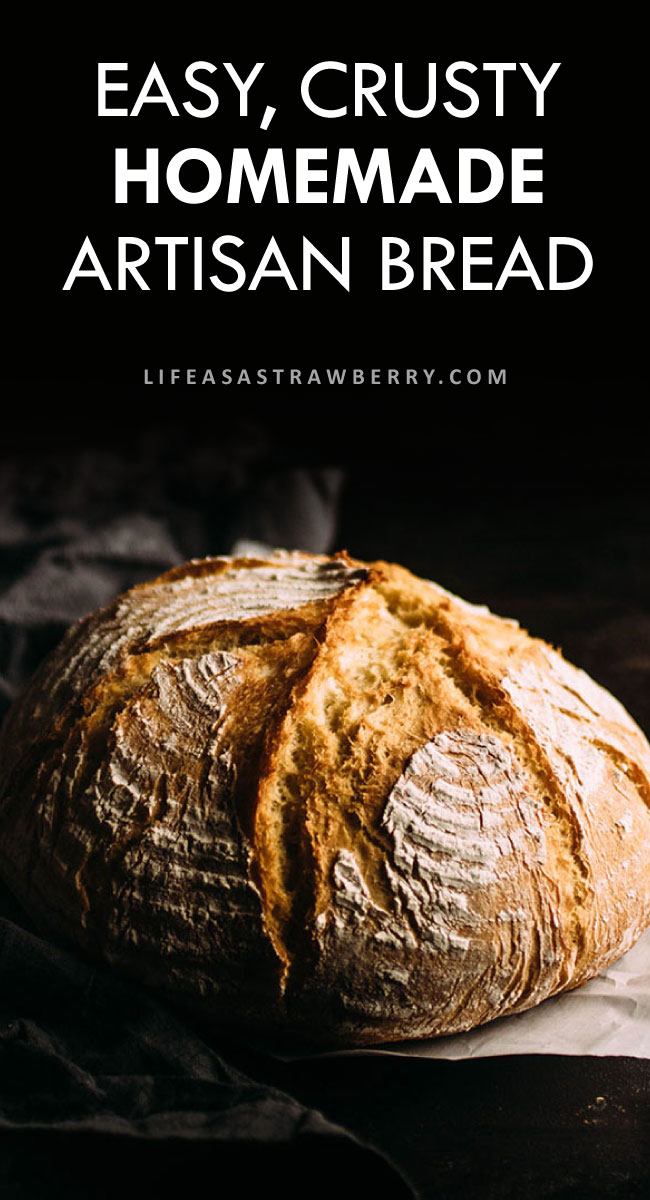
This easy (and we mean EASY!) homemade bread recipe is sure to be a hit! Homemade dutch oven bread that's ready in just a few hours - no overnight rise. Crispy crust on the outside and soft, airy bread on the inside! Vegetarian.

WE NEED TO TALK ABOUT THIS BREAD. ⬆⬆⬆ ⬇⬇⬇
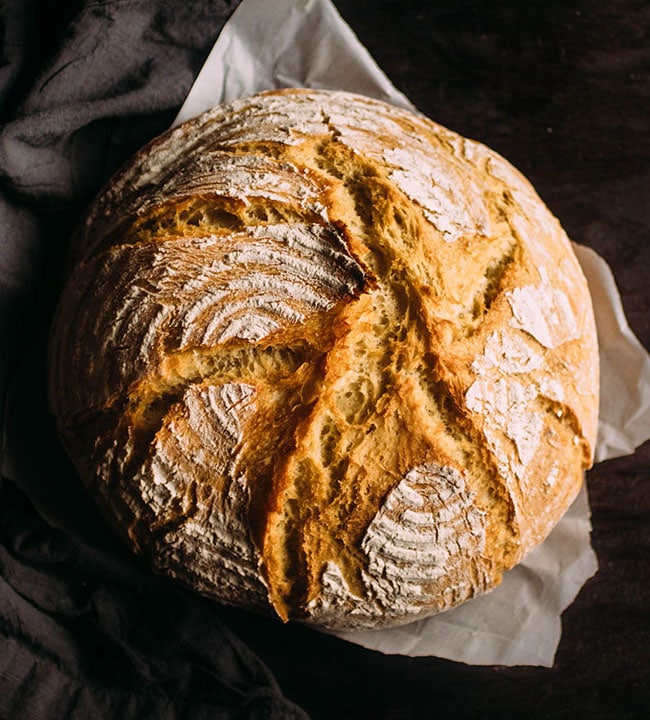
What you need to know about this crusty bread:
- It's ready in under three hours. No overnight rise necessary!
- It's ultra-forgiving. Read through ALL of our recipe notes for best results!
- No Dutch oven? You can still make great bread - check out this post for our best tried-and-true alternatives.
- YOU CAN MAKE THIS BREAD ⬇⬇⬇. I PROMISE.
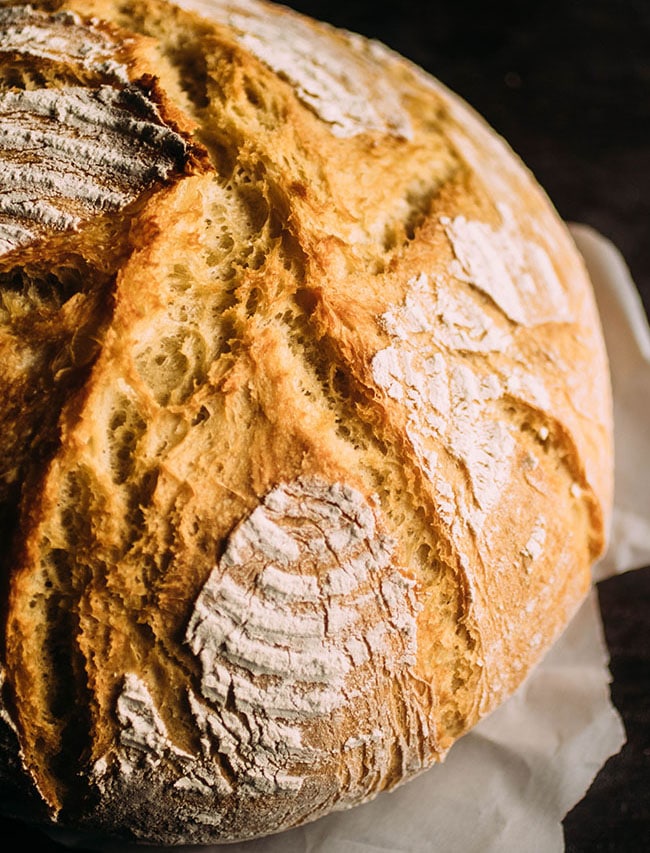
The basic order of operations for this artisan bread:
The instructions may look a little long, but they're all basically just notes on technique - so don't let the number of steps intimidate you!
After a couple of adventures with this bread, you'll be able to throw it together in your sleep.
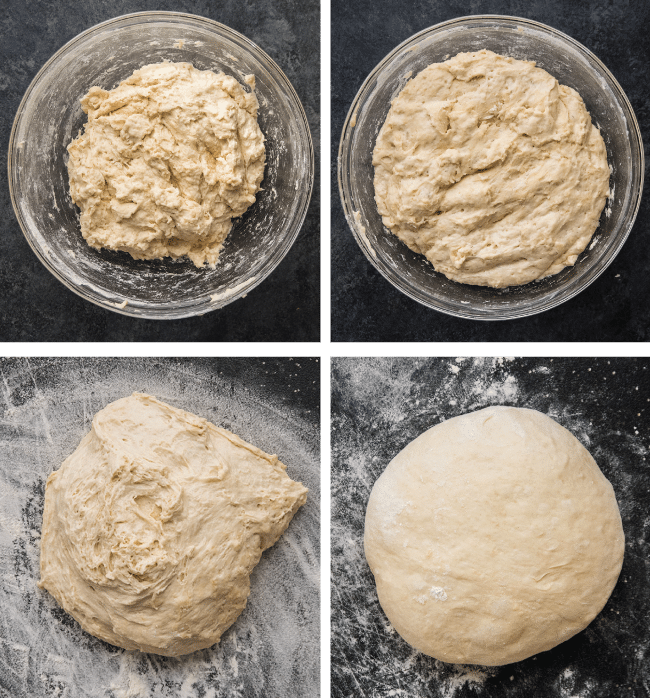
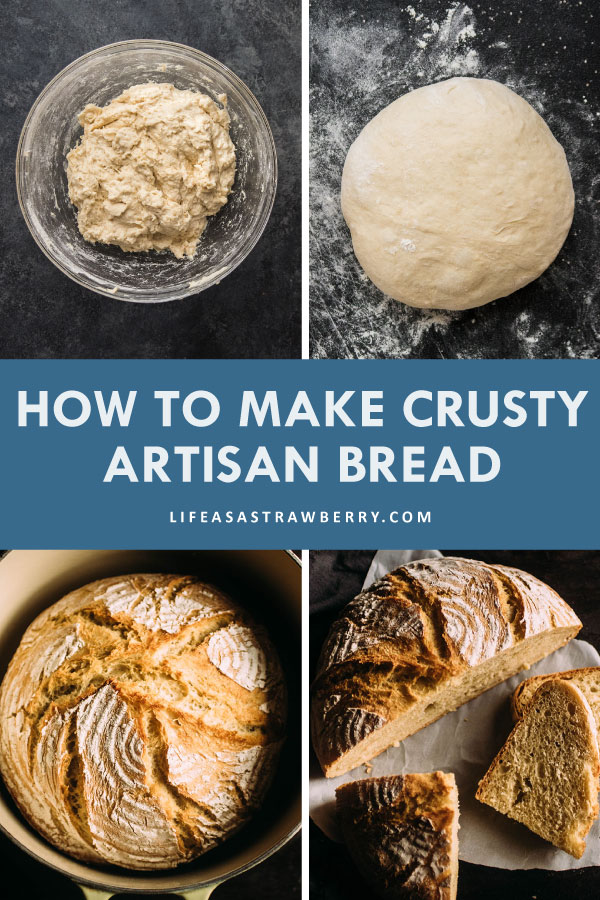
- Mix the dough (10 minutes) This is a very slack dough (also known as a wet or sticky dough) - it won't form a ball or be immediately elastic like some recipes you might be used to! The dough will be shaggy and somewhat sticky, but it will smooth out as the gluten develops while it rises and again when it's time to shape.
- Let the dough rise (1 hour) Kick back, relax, and let your dough do it's thing!
- Shape the dough (5 minutes) Lightly flour a cutting board, tip the dough out, and gently form it into a round loaf (watch the videos below to see exactly how we do this!)
- Let the dough rise one final time (30 minutes) When your dough is shaped, pop it into a medium-sized bowl or proofing basket to rise for 30 minutes while you preheat the oven.
- Bake (45 minutes) Carefully transfer the bread to your preheated Dutch oven (or use an alternative method!) I like to use a piece of parchment paper to make it easier to lift the bread in and out of the pot. Bake for 30 minutes with the lid on, then remove the lid and bake another 10-15 minutes to help the bread develop more color.
- Let the bread cool, slice, and enjoy!
If you're serious about homemade bread, you may enjoy using a proofing basket (it's one of my favorite kitchen tools!) to help the bread keep its shape while it rises. You also end up with beautiful flour rings on the crust! We like to use an 8- to 9-inch proofing basket for a single loaf of bread.
If you don't have a proofing basket, no worries! Just use a medium-sized (8- or 9-inch diameter) mixing bowl to let the bread do its final rise before you bake it. Flour the bowl well to prevent sticking!
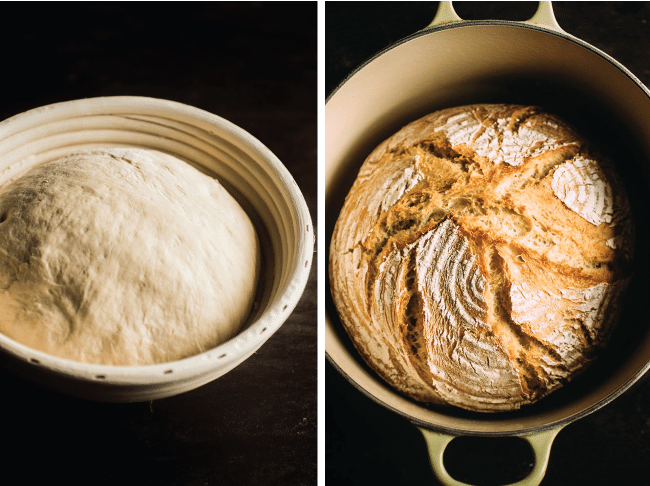
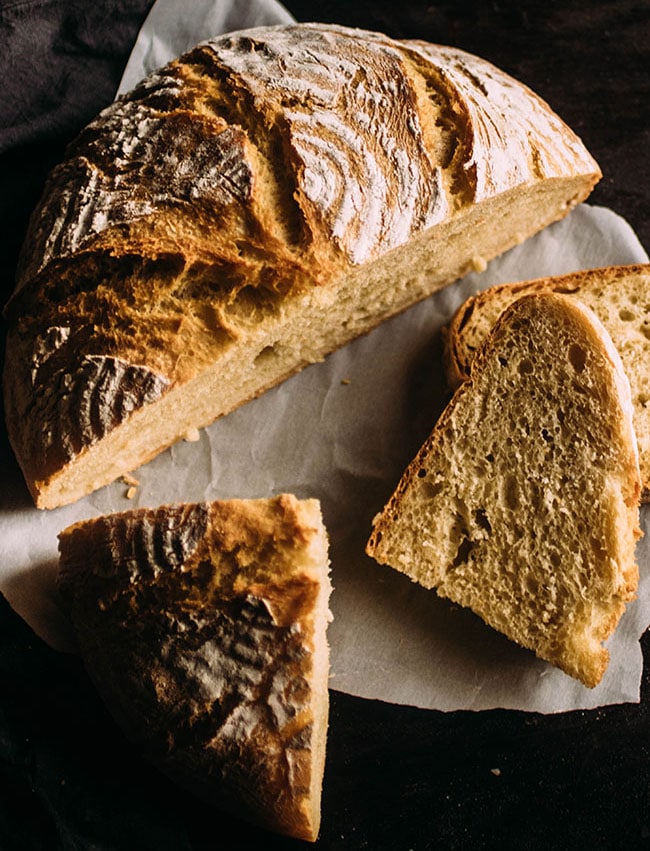
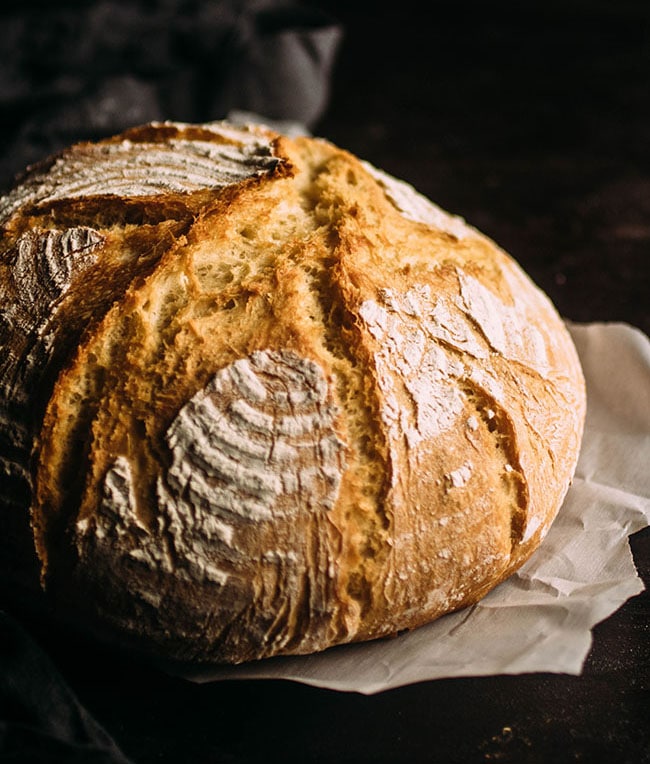
The crackly brown crust here is the result of baking this bread in a Dutch oven. By keeping the lid on while the bread bakes, you create a nice steamy atmosphere inside the pot - and the steam is what gives the bread that crispy, magical crust. (Read more about the importance of steam in bread baking here!)
HOMEMADE BREAD FAQ
This section is LONG - but we wanted to cover the most frequent questions we get! Feel free to skip right to the recipe, but please do utilize this section if you run into questions while you're baking. For additional training videos, tips, and recipes, check out Everyday Artisan Bread!
- My dough feels too wet. This is a very slack (wet) dough - the dough should feel quite shaggy and a bit sticky when mixed. This dough should NOT pull away from the sides of a bowl into a smooth, elastic ball like other recipes you may have used. Don't worry - it will become more elastic as gluten develops while the dough rises! If you are still worried about the consistency of the dough, feel free to mix in more flour ¼ cup at a time - especially if you measured your flour by volume (in cups, which can frequently result in using too much or too little flour) rather than by weight with a kitchen scale.
- Related: Please use a kitchen scale! If you already have a scale, please use it. Just set the scale to grams, place an empty bowl or container on top, set the scale to zero, and add your ingredients until it reaches the right weight. If you don't have a scale, you can still make great bread without it - just make sure to follow the notes in the recipe below - but if you plan to bake bread a lot, a scale is definitely worth the investment!
- Can I use rapid rise or instant yeast for this recipe? Yes - just reduce the amount of yeast to 1 ½ teaspoons (about 25% less than we use with Active Dry Yeast).
- How do I stop the bottom of my loaf from burning or overbaking? There are a bunch of ways to adjust if the bottom of your bread is burning! 1. use an oven thermometer to check the true temperature of your oven (I've had ovens that are off by as much as 40 degrees in one direction!) 2. Make sure your oven rack is in the center of your oven (or, if burning occurs while baking in the center of your oven, move your rack one notch farther away from your heat source). 3. Try placing a sheet pan directly underneath your Dutch oven when baking to redistribute some of the heat, or 4. preheating your Dutch oven for half the time. 5. Some testers also have good luck placing a baking steel or pizza stone on the rack directly below the Dutch oven, again to redistribute some of the heat. 6. Make sure to use a piece of parchment paper to lift the bread in and out of your Dutch oven. 7. Dust the bottom of your loaf with a thin layer of cornmeal before placing it into the Dutch oven to form a barrier between the dough and the hot surface. 8. Try preheating and baking at a slightly lower temperature (between 425 and 450 degrees F) OR preheating at the suggested temperature of 460 and then turning the oven down to 425 degrees F once you put the bread in. Don't worry if it takes a few tries to find your sweet spot - ovens and equipment can vary wildly when it comes to heat distribution, and a big part of bread baking is figuring out your oven's own unique quirks so you can consistently get the results you want!
- Can I double this recipe? Yes - double everything except the yeast in this recipe for best results*. After the first rise, divide the dough in half and form two loaves (our preference) or form one large loaf. If you bake a large loaf, you will likely need to extend the bake time and it may not cook quite as evenly - just keep an eye on it and use your best judgment! (*the converter in the recipe card below may tell you to double the yeast as well, but you really don't need to. We just can't figure out how to turn the converter off *facepalm*)
- Can I halve this recipe for a smaller loaf? Yes! We have a scaled-down version of this recipe (with adjusted measurements and instructions!) in our Small Batch Crusty Bread post.
- How hot should my water be? A good rule of thumb is "warm to the touch." Too-hot water (typically 130-140 degrees F and above) will kill your yeast, but use too-cold water and your yeast will take too long to activate. We typically use water that's between 95 and 110 degrees Fahrenheit for our Active Dry Yeast. You should be able to comfortably hold your hand under water running at about 100 degrees - it should feel warm, but not hot. Use a kitchen thermometer for a precise measurement if you like!
- A note about salt: Every brand of salt will perform a little differently. If you're measuring by volume, using Morton Kosher Salt, 1 ¼ teaspoons is usually plenty. If you're using Diamond Crystal Kosher Salt, you may want to use 1 ½ teaspoons since it's significantly lighter/less salty than other brands. If you're using table salt, you'll typically be fine sticking to 1 ¼ teaspoons, but if you prefer less salt in your food, you can dial it back to 1 teaspoon. We recommend measuring your salt by weight to keep things simple!
- What kind of Dutch oven should I use? We recommend using a 4- to 6-Quart Dutch oven. We have tested our artisan crusty bread recipes in Le Creuset, Lodge, Staub, and Marquette Castings Dutch ovens. All work well! Le Creuset and Staub are generally our favorite brands - they do a great job of controlling and evenly distributing heat, and are especially easy to clean. Lodge and Marquette Castings also work well (though if you're used to a Le Creuset, you may notice some differences) and are perfect if you're looking for a budget-friendly option.
- Can I bake this bread without a Dutch oven? Definitely! Read this post for our favorite Dutch oven alternatives (you likely have most of them in your kitchen already!)
- What kind of flour should I use? After extensive testing, we recommend King Arthur All Purpose Flour or Bob's Red Mill All Purpose Flour. If you have bread flour and would like to use it, you certainly can! But it's not necessary. If you don't have Bob's or King Arthur, use whatever All Purpose Flour you have on hand (but add one of those brands to your list for next time - you'll notice a difference!) The only flour we do NOT recommend is Pillsbury - it was consistently the toughest flour to work with in our testing and always created a dough that tore rather than stretched (which we don't want here!)
- How should I store this bread? Store half-loaves cut-side down on a cutting board on the counter for up to 24 hours (no need to cover!) to keep the crust crispy and the interior moist. Store sliced bread in an airtight container in the freezer for 3-4 months (toast it up as needed!) or in an airtight container on the counter for 3-4 days. Freeze a full loaf by wrapping the bread in plastic wrap and popping into the freezer for 3-4 months, then defrost on the counter for a few hours when you're ready to eat (we prefer to avoid plastic, but haven't found a better alternative for this yet - bee's wrap just doesn't do as good of a job here!)
- Can I make this bread with whole wheat flour? Yes! Check out our whole wheat crusty bread recipe.
- My bread didn't rise, or it doesn't have enough big air pockets. Because this is a quick bread recipe with a short rise time, it will typically be a shorter loaf with a tighter crumb (fewer air pockets) than a sourdough recipe or a yeast bread that rises for 8+ hours. If you'd like bigger air pockets and/or a taller loaf of bread, give the gluten in the dough more time to develop by mixing the dough, covering with plastic wrap or a reusable bowl cover, and letting it rise in the fridge overnight. The next day, bring dough to room temperature on the counter, shape and bake as directed! PS - We have a ton of different baking timelines and tips like this in our course!
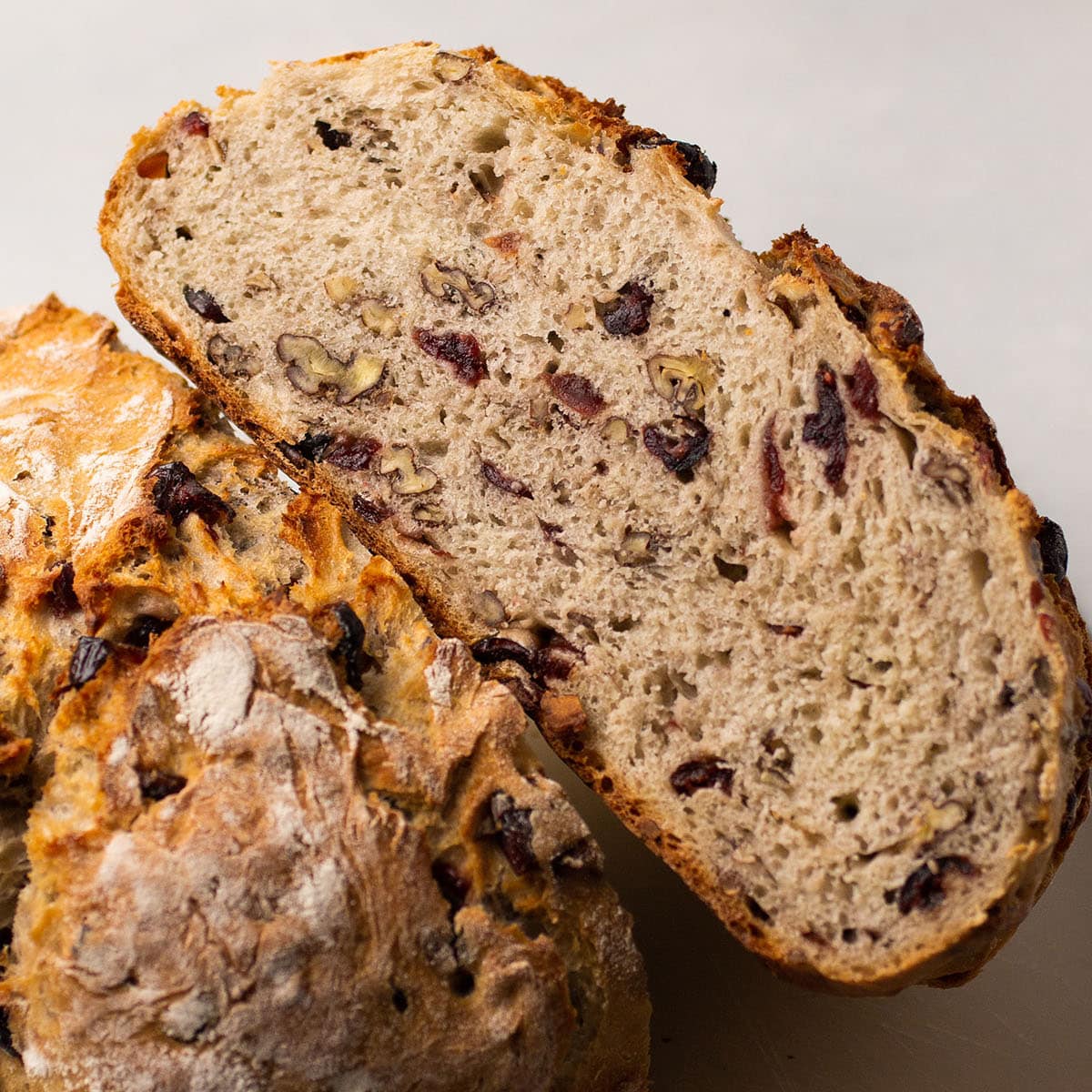
- Can I add fruits, flavors, or other mix-ins to this bread? Yes! Check out our Roasted Garlic & Rosemary Crusty Bread or our Easy Crusty Asiago Bread for a few of our favorite flavors. Add fresh or dried herbs, spices, roasted garlic, nuts, or dried fruit to the dough right when you mix it. For anything that may release more moisture - fresh fruit, olives, etc. - we recommend folding it in as you shape the bread. Pull the dough into a large circle, spread an even layer of mix-ins across it, then fold dough into the center as directed and repeat until you've added all of the mix-ins.
- Why did my loaf flatten or not hold its shape? Typically, this happens when we haven't built enough strength into the dough before baking. Because this is a relatively quick bread recipe, we lose out on the strength that builds while gluten networks develop over a long rise - so we build strength into the dough by folding it over on itself many times during shaping. If your loaf isn't as tall as you'd like, first be sure to thoroughly mix the dough so that no dry bits of flour remain. You may also want to knead the dough a few times by hand (you can do this right in the mixing bowl) or let your mixer run an extra minute or two with the dough hook attachment. Next, while the dough does its first rise, you can perform one set of "stretch and folds" at the half hour mark to increase strength. Finally, when shaping the dough, be sure to fold the dough over on itself several times until the dough feels tight and begins to resist your folding. Keep in mind that because this bread is made on a quick timeline, it won't typically rise as high as a hearty sourdough loaf or other bread that has had hours or even days to proof. We cover a ton of techniques to bake taller, more open bread in our online course.
- Why don't you transfer the dough to an oiled bowl during the first rise? We don't find it's necessary to add this extra step with this quick recipe, and we wanted to keep it as simple as possible. We just let the dough rise right in the mixing bowl and then run our hands under cold water to coax the dough out without sticking when it's time to tip the dough onto the cutting board. You can absolutely transfer the mixed dough to a lightly oiled bowl for its first rise if you like! A previous version of this recipe had you add a dusting of flour during this first rise; we omitted this step in later revisions to simplify the instructions.
- What is the hydration of this loaf? If you're familiar with baker's percentages, this bread is about 75% hydration by weight as written.
Trouble playing a video? Try disabling your ad blocker.
VIDEO 1: HOW TO MAKE CRUSTY BREAD WITH A STAND MIXER (NO PROOFING BASKET)
VIDEO 2: HOW TO MAKE ARTISAN BREAD BY HAND (WITH PROOFING BASKET)
VIDEO 3: HOW TO SHAPE A LOAF OF BREAD (TUTORIAL)
This video tutorial is an excerpt from our online course, Everyday Artisan Bread!
📖 Recipe
Easy Crusty French Bread
- Prep Time: 15 minutes
- Inactive Time: 1 hour 30 minutes
- Cook Time: 45 mins
- Total Time: 2 hours 30 minutes
- Yield: 1 loaf (about 6-8 servings) 1x
- Category: Bread
- Cuisine: American
- Diet: Vegan
Description
Easy dutch oven bread ready in just a few hours - no overnight rise needed.
Ingredients
- 2 ¼ teaspoons active dry yeast (9 grams)
- 1 teaspoon sugar (4 grams) (use honey if you prefer)
- 1 ¼ cups warm water (300 grams)
- 1 ¼ teaspoons (8 grams) kosher salt
- 2 ½ to 3 ½ cups All-Purpose Flour (400 grams) plus extra for dusting (see recipe notes)
Instructions
MIX THE DOUGH & FIRST RISE (1 HOUR):
- Combine yeast, sugar, and warm water in a large mixing bowl (you can also use a stand mixer fitted with a dough hook).
- Let the yeast proof for about 5 minutes, until the mixture is foamy.
- Add flour to bowl. Mix with a sturdy spatula until the dough starts to come together, then add salt and mix until all ingredients are incorporated. For best results, mix until no dry bits of flour remain. Note: This is a relatively slack (wet) dough, so it may seem a bit shaggy and sticky at this point. Don't worry - it will become more smooth and elastic as we go!
- Cover bowl with a clean tea towel and let rise on the counter for about 1 hour, until dough has doubled in size.
SHAPE THE DOUGH & FINAL RISE (30 MIN):
- When dough has risen, lightly flour a large cutting board.
- Tip the dough out of the bowl and onto the cutting board. DO NOT PUNCH THE DOUGH DOWN - you want to keep all those nice air bubbles intact so you have an airy, delicious loaf of bread. (Note: If the dough is sticking to the bowl a little bit, wet your hand with a bit of cold water and gently separate the dough from the bowl to get it all out).
- Shape the dough into a round loaf: Pull each corner of the dough in towards the center (like you're folding an envelope) and repeat until the dough feels tight and begins to resist your folds. Flip the dough over and pull it into a round loaf. Watch the video(s) above to see exactly how we do this!
- Flour a proofing basket or a medium bowl and place your loaf into it seam-side down. Cover with a tea towel and let rise another 30 minutes or so while you preheat the oven. Note: I like to line my proofing basket or mixing bowl with a clean linen napkin to distribute the flour more evenly and help with cleanup.
HEAT THE OVEN :
- While bread is rising, place an empty dutch oven (with the lid on) in your oven and heat to 460 degrees Fahrenheit.
BAKE!
- When the oven is hot, you're ready to go! Use oven mitts to pull the dutch oven out and remove the lid.
- Lay a piece of parchment paper down on your counter or cutting board (optional - it makes transferring the bread easier!)
- Tip your bread dough gently out of the proofing basket onto the parchment paper. Make sure the seam side is up this time - this is what will create those beautiful cracks on top of the bread!
- VERY CAREFULLY (without burning yourself!) use the sides of the parchment to lift the bread up and place it into the hot Dutch oven.
- Put your oven mitts back on, place the dutch oven lid back on the pot, and slide the whole thing back into your hot oven.
- Cook bread for 30 minutes.
- After 30 minutes, remove the lid from your dutch oven. The bread should be taller, crusty, and very lightly browned. Continue cooking the bread, uncovered, for 10-15 minutes more until the bread has deepened in color and you have a beautiful brown crust.
- When bread is done, use oven mitts to pull the pot out of your oven.
- Use a long spatula or the corners of your parchment paper to lift the bread out of the dutch oven and onto a cooling rack. Let cool for at least 30 minutes before cutting into it.
- Slice, slather with butter, and enjoy!
Notes
How to measure flour: If you have a kitchen scale, please use it! Measuring by weight is MUCH more accurate than measuring by volume (with cups) and will give you more consistent bread. That being said, you can certainly make great bread without a kitchen scale! To measure flour in cups: If you measure flour by dipping your cup straight into the bag or bin and shaking off the excess, plan to use about 2 ½ cups of flour. If you measure by stirring the flour with a spoon or scoop before scooping it into a measuring cup and leveling it off, plan to use about 3 cups of flour. You can always add more flour if you need to - just be aware that this is a relatively slack (wet) dough, so it will be a bit shaggy and sticky at first (but it will smooth out and become more elastic as it rises and again as you shape it!)
Equipment. We recommend a 4- to 6-quart Dutch oven for best results. Le Creuset and Staub are our favorites, but Marquette Castings and Lodge also make solid options that are more budget-friendly. If you don't have a Dutch oven, see this post for alternative baking methods (you can still make great bread without fancy equipment!) Please make sure that your Dutch oven is fitted with a metal (rather than plastic) knob on its lid for best results, and please check the care instructions on your individual equipment before baking. We use this 8.5-inch proofing basket, but an 8- or 9-inch banneton or medium-sized mixing bowl also work well for the final rise.
PLEASE READ THE POST ABOVE FOR OUR COMPLETE FAQs, TIPS, AND ADVICE. We've gotten so many amazing questions from you - we wanted to be sure to answer as many as we can as thoroughly as we can, but if we put our answers here in the recipe it would make it very annoying to print. Please check the FAQ section in the post above if you have a question or run into a problem!
Love this recipe? We'd love to see you in our online course, Everyday Artisan Bread, where we share exclusive training videos, worksheets, and ad-free recipes!
Nutrition
- Serving Size: ⅙ of a loaf
- Calories: 250
- Sugar: 0.9 g
- Sodium: 585.5 mg
- Fat: 0.8 g
- Carbohydrates: 52.2 g
- Protein: 7.5 g
- Cholesterol: 0 mg
HUNGRY FOR MORE? OUR FAVORITE BREAD RECIPES AND RESOURCES:
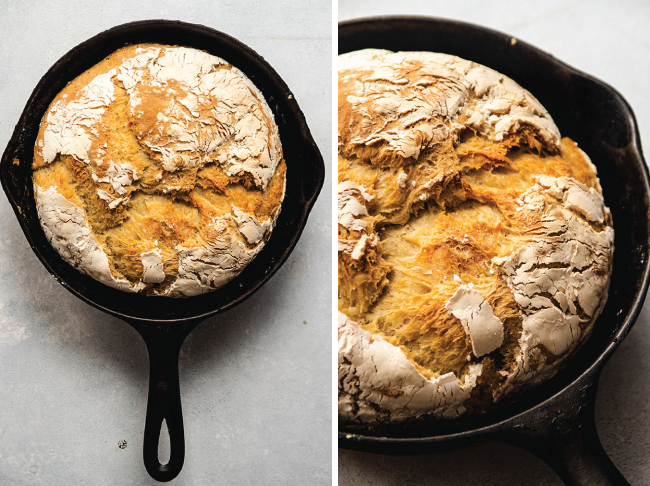
How to Bake Crusty Bread Without a Dutch Oven
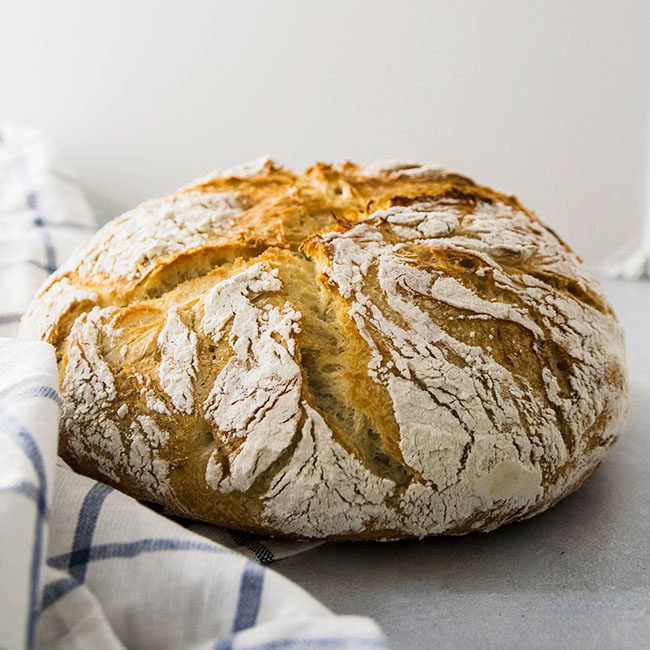
Roasted Garlic and Rosemary Bread
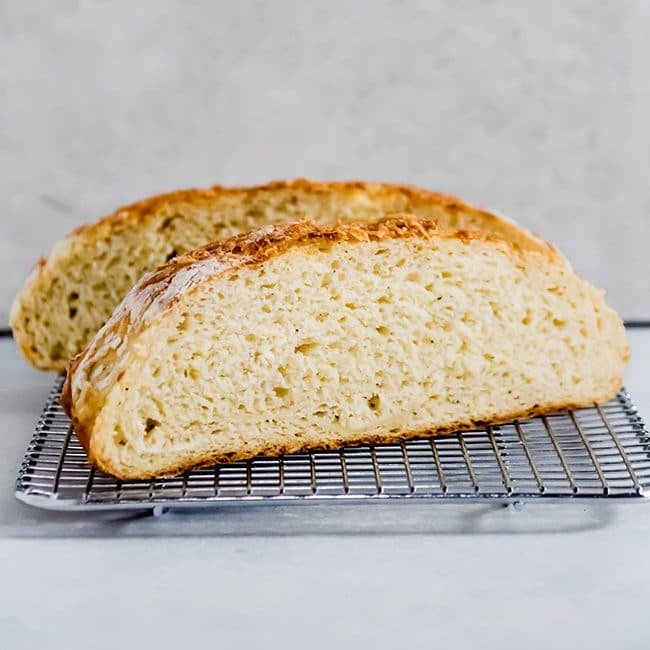
Easy Crusty Asiago Bread
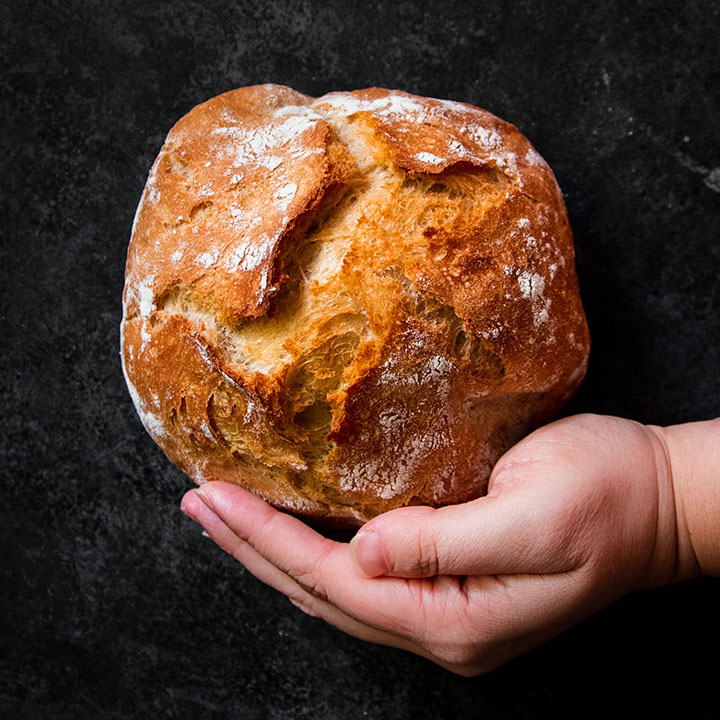
Small Batch Crusty Bread (Perfect for Two!)
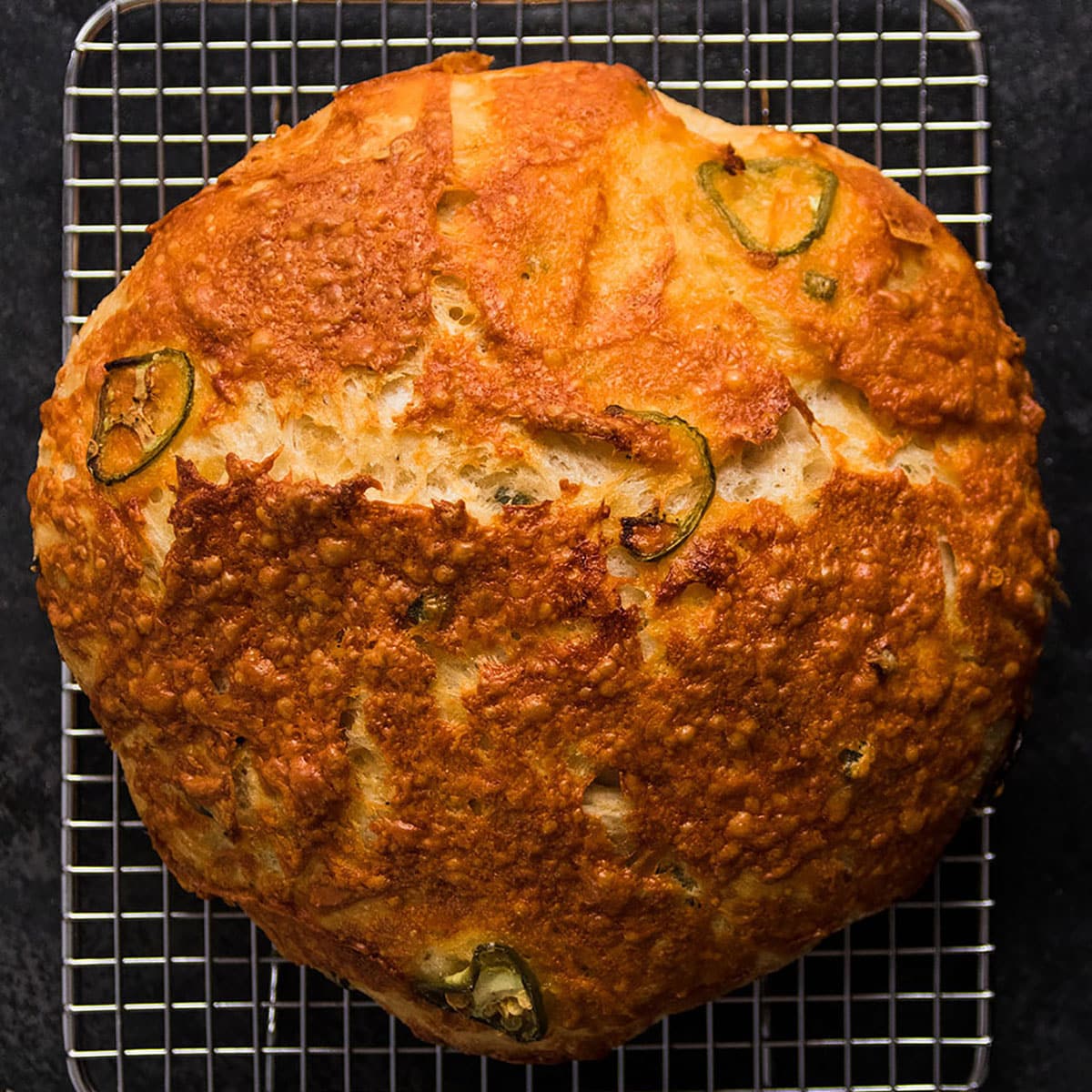
Jalapeño cheddar loaf
Deb
Bad luck with this recipe. Took a lot more than 2.5 c of flour, more like 4. I've made a lot of bread but this one did not work out. It rose, then fell while baking. Hard crust. Raw inside.
Jackie @ Life As A Strawberry
Hi Deb - I'm sorry to hear you had some trouble. Maybe read through other comments, many people have found success with this recipe. They may be able to help you out!
Carla
I have made this bread over 2 dozen times and it come out perfect each time. My only complaint is that the loaf is not as high as I would like. I was using 6 qt Dutch oven, so today I tried my 2 qt Dutch oven and it came out perfect! Nice night loaf, a bit smaller but that’s ok. I followed the same baking times
Jackie @ Life As A Strawberry
Hi Carla, thank you for sharing. This is helpful for others.
Joyce Morawski
Hello from sunny Singapore! This is my first time making a rustic loaf.. and your recipe nailed it! I didn’t have a Dutch oven, and so I baked it normally for 235c uncovered. I added some ice to the bottom tray in the oven to create the crispy crust- and it worked well! Thanks so much for the recipe- it is a definitely keeper!
Michelle
Thank you so much! I’ve never baked anything like this before and it worked out awesomely! I used my Le Creuset pot for the Dutch oven and it was fine as well. Love your site! Thank you!
Michelle- Halifax, Nova Scotia, Canada
Jackie @ Life As A Strawberry
Hi Michelle - thank you! We love to hear these stories, thanks for sharing!
Faith
I have made this plain several times, but today I booked the water with rosemary, let it cool, and used it for the water in the bread(with some rosemary leaves) and mixed in cloves of roasted garlic, it was amazing.
Jackie @ Life As A Strawberry
Hey Faith, wow - love that idea! Sounds yummy! Thanks for sharing.
CrustyBread
So easy. Have you experimented with pepitas, sunflower, flax, poppy, and sesame seeds? If so, I'd love to know the ratios.
Kirsten
If I use rapid rise instant yeast instead do I still need the water from the recipe? Do I still dissolve the yeast and sugar in the water? Sorry if this is a dumb question. I’m new to bread making. Thanks!
Aleisha
Hey Kirsten! I was wondering the same so I made it today using rapid rise yeast. I still dissolved the rapid rise yeast and sugar into warm water and left it for 10 mins until it was foamy on top and continued the recipe like normal. The bread turned out fantastic and tastes delish!
CatznDogz22
HIGH ALTITUDE ADJUSTMENT: I live in Denver and have made this twice now and it's fantastic! To adjust for altitude, I reduced the yeast to 1 3/4 t. and punched the dough down twice. Bread rises too quickly here and forms air pockets that are too big, which leaves the final product dry. That's where punching down the dough helps. After I mixed the ingredients, I let it rise in the original mixing bowl for about 30 minutes until it was double in size, punched it down, added a light coating of flour to keep it from sticking and let it rise in the same bowl for another 30 minutes(ish) until it was again double in size. I punched it down a second time, rolled it out of the bowl onto a piece of parchment paper, folded in the edges, as described above, and placed it in the proofing basket to rise a third time. From there, I followed the recipe as written. Great recipe! Thanks!
Jackie @ Life As A Strawberry
Wow! Thanks for putting this out there, good for others to have a reference.
CrustyBread
Denver here too. I use a whole envelope of active yeast, which is under the recipe's amount. Then I measure 345g of bread flour and keep the other ingredients as listed. I follow the recipe exactly from here on out and it turns out perfectly. No need to punch down unless you're just feeling angry that day.
nishita gupta
absolutely loved the bread.
the water was a bit too much, so I added twice the amount of flour. - which I think made the bread slightly dense In certain areas.
I use a convection oven, and I do not have a dutch oven, so I baked it on a cookie sheet at 240 degrees Celsius for 40 minutes.
the crust was superb and so was the taste.
overall I was very happy with the outcome.
Jackie @ Life As A Strawberry
Hey Nishita,
Love how you made it into your own thing! So happy it worked out, great job!
Jake Risch
SO GOOD. It's near identical to restaurant quality bread. If you want a bread to take to a dinner or an event, use this one. People might not even know that you baked it yourself.
Denisa @ BreadNewbie
Jessie, FOR REALZ FOR SERIOUS this is a great recipe! I love the pictures, yummy! I haven't used a Dutch oven for baking bread before but I'll give it a try.
Jackie @ Life As A Strawberry
Hi Denisa, we love hearing when someone enjoys the result of the recipe! Yay!
Maddie
I made this once before and it was wonderful! I want to make it again but I'd like a larger loaf. If I double the recipe, do I double the baking time?
Jessie
Hi Maddie! You shouldn't need to double the baking time, but you'll likely need to give it an extra 10-15 minutes depending on your pot and the size of your loaf. Some other commenters have left their tips for doubling the recipe below if you want to check it out! I'd recommend adding an extra 5-10 minutes to the cook time before removing the lid, and then adding extra time as necessary until it's developed a nice, dark crust. To check if it's done, turn the loaf over and give it a light knock - it should sound hollow when it's done (although this test takes a bit of practice to recognize the sounds)! Hope that helps!
Ari
This is a GREAT base recipe, but it really does need more flour. The dough should not be so wet that it’s sticky.
I adjusted the recipe and made a seedy/heartier loaf by adding hemp hearts, flax seeds, pepitas, roasted sunflower seeds, and soaked wheat berries. I also subbed a cup and a half of flour for whole wheat flour, and subsequently added 2 tablespoons of vital wheat gluten. I don’t have a Dutch oven, so I baked it on a cookie sheet at 420° for 30 mins and it came out perfectly. I also added a bread pan to the bottom rack while the oven was preheating, and tossed a handful of ice into it after inserting the cookie sheet. The steam helps create a hard, thick crust. Freaking delicious!
Jackie @ Life As A Strawberry
Hello Ari, thanks for the feedback.
Elaine
Thank you so much for this. Ive just made it amd served it with lamb stew. My kids helped make it and they really enjoyed it
Jackie @ Life As A Strawberry
Hello Elaine, I'm so happy you enjoyed it and we love hearing when cooking can be used as a family activity!
Sara W
Question: I’m not a newbie to breadbaking, but I’m not a master by any means. I’m not sure what happened... everything was going just peachy until I went to turn the dough onto my board to do the folds prior to placing it into bowl for final proofing. I was extremely gentle, and it still deflated, never to ride again.. tips plz
Jessie
Hi Sara! It's hard to say without being in the kitchen with you, but my first instinct would be to ask how long you proofed (let the bread rise) for on the first rise - I've had bread totally collapse on me sometimes if I've overproofed it (too long or at too high of a temperature). It may also need a little extra time on the second rise, depending on the temperature in the kitchen - when it's colder, I find it needs a little more time in the proofing basket. Since it rose fine at first, I doubt there's a problem with your yeast. Sometimes I also have bread that doesn't rise as much as I want on the counter, but I bake it anyway and it pops right up once it's in the oven! I hope that helps!
Dawn Warrington
I'm a complete novice but making this every week now. Can I add additional flavurs?
Jessie
Absolutely! I love adding herbs, roasted garlic, black pepper, cheddar, or olives to this recipe - just mix them in when you're first mixing the dough! I also have my favorite asiago version of this bread on the blog here: https://www.lifeasastrawberry.com/easy-crusty-asiago-bread/