

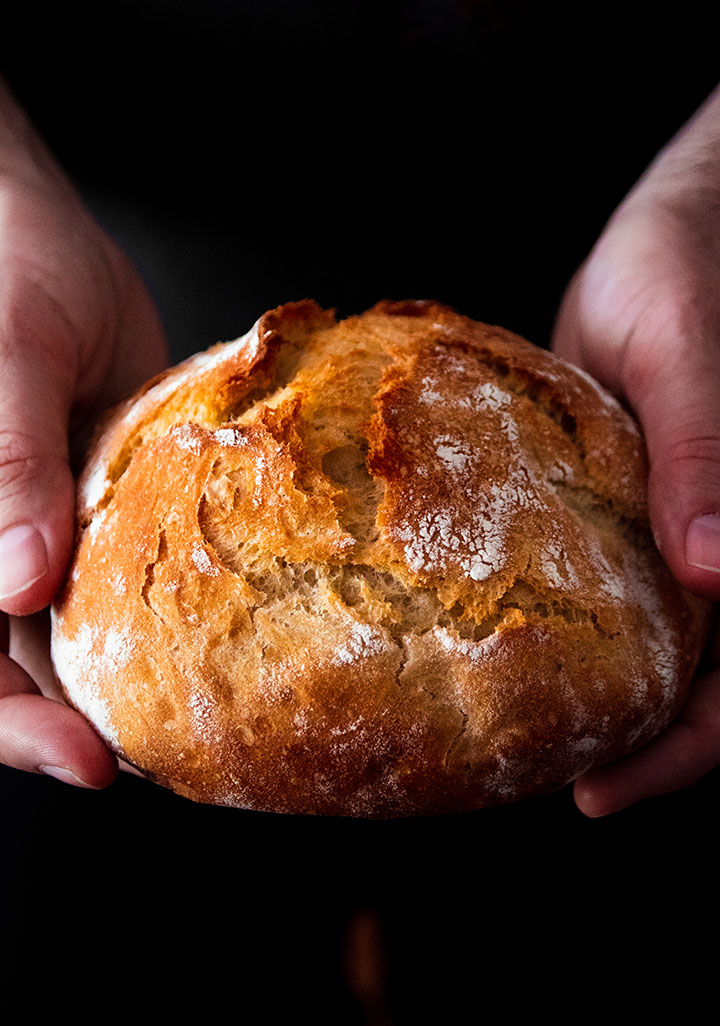
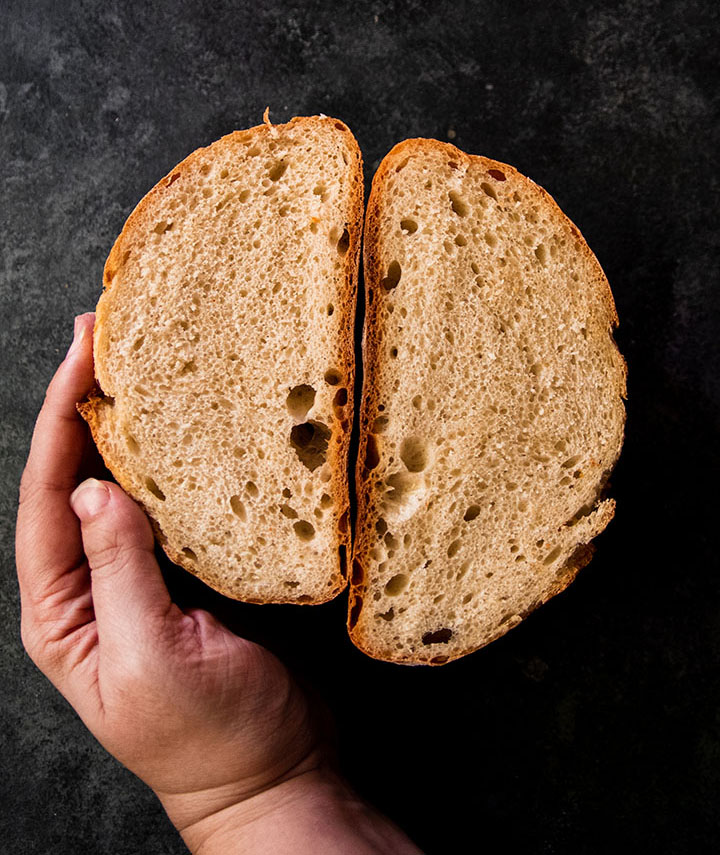
This small batch crusty bread recipe has a thin, crispy crust and a soft interior. Ready in just 3 hours (with no kneading required). The perfect size for two or three people!

We've taught thousands of people to bake their first loaf of bread with our best Easy Crusty French Bread recipe. And while we love digging into that giant loaf, we know that sometimes you just don't need that much bread!
Enter: This small batch crusty bread recipe.
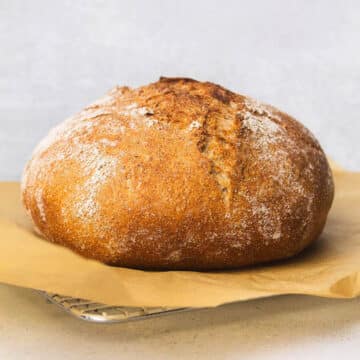
(Also: How FREAKING CUTE is this lil' mini baby loaf?! I'm in love).
This is a scaled-down version of our classic no knead artisan bread, and it's perfect for just a few people! It makes a small loaf that fits easily in the palm of your hand - typically about 6 inches in diameter.
I make this small batch loaf with soup or stew for two people; if we're making sandwiches or crostini, it will serve 4. I usually get about 10 half-inch slices of bread with this recipe.
PS - If you've made our original recipe before, you'll notice a few small differences here: we tweaked some things to keep this loaf of bread extra simple, and we adjusted the cook time to account for a smaller size.
How to make this small batch no knead bread
Mix the dough (10 minutes)
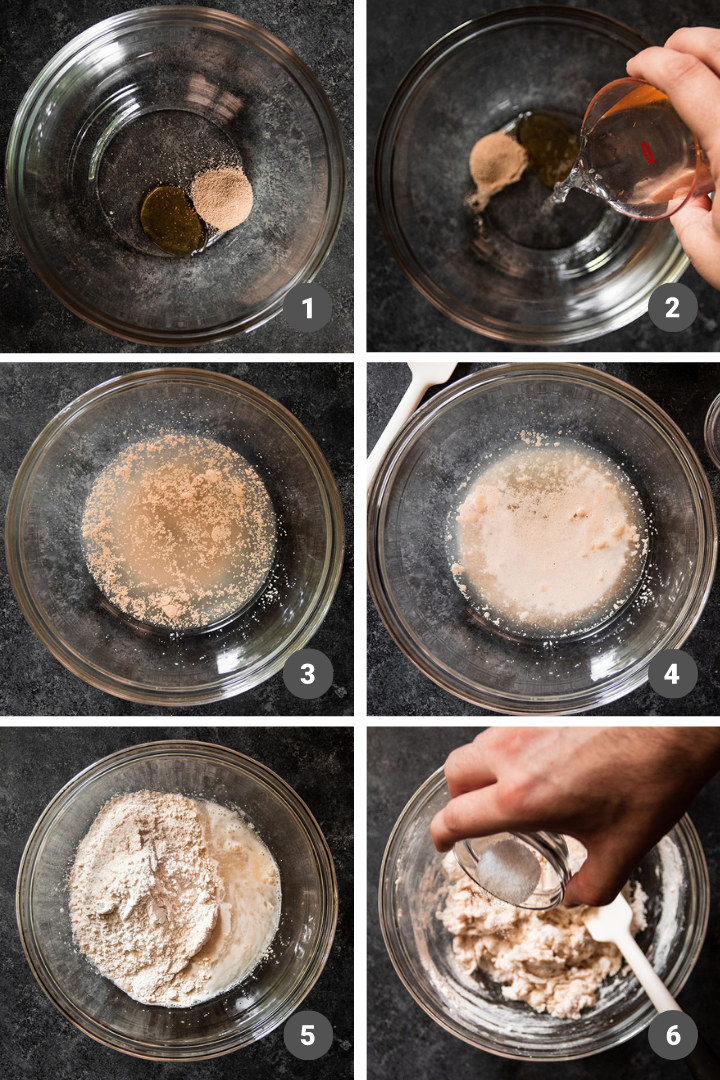
Mix active dry yeast and a bit of honey with warm water, then let that mixture sit for a few minutes until the yeast activates and foams. Next, mix in the flour and salt. Stir everything together until no dry flour remains and you have a nice, shaggy dough.
Let it rise (1 hour)
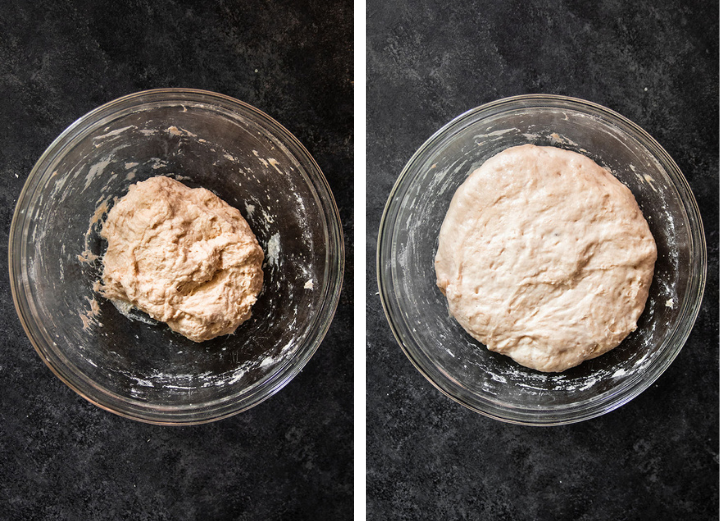
Cover the dough with a clean towel and let it rise for about an hour until it's doubled in size.
Shape your loaf & final rise (30 minutes)
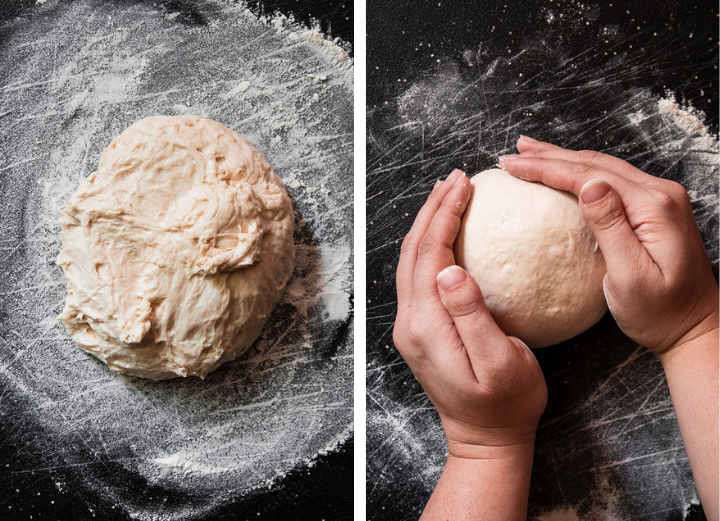
Shape the dough into a boule (see the video below for how to do this!) and let it rise another 30 minutes or so in a small mixing bowl or proofing basket while you heat the oven.
Bake! (30 minutes)
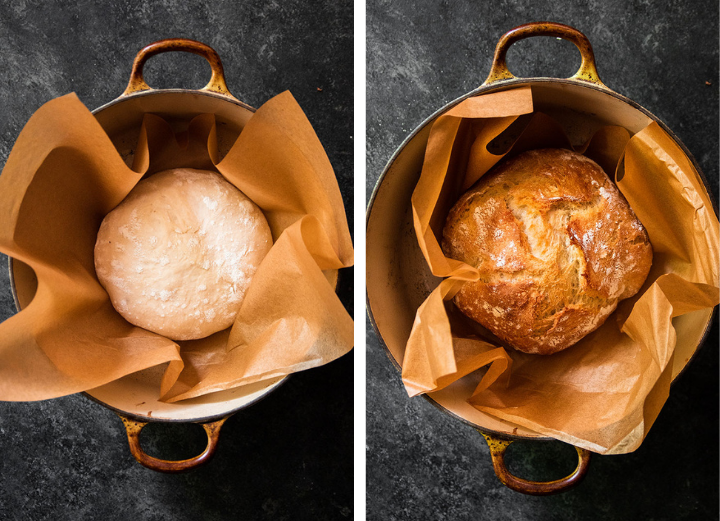
Bake your loaf in a hot Dutch oven (or use one of our other methods!) for 22 minutes with the lid on, then remove the lid and bake another 5-10 minutes to give the crust some more color.
A few tips for successful loaves
- Use a kitchen scale if you have one! Measuring by weight (with a scale) is much more accurate than measuring by volume (with cups). If you have a kitchen scale, please use it! (No kitchen scale? Measure your flour with the scoop and level method for best results!)
- Great bread takes patience and persistence. When you're first learning how to make crusty French bread at home, it might not look exactly like these pictures. THAT'S OKAY! The more you practice, the better your bread will get. Stick with it!
- Use high-quality flour. Trust us: The type of flour you use matters. A LOT. We recommend baking with King Arthur Flour or Bob's Red Mill flour for best results - these flours are the most consistent, and they both have a high protein content (which gives you a stronger, more elastic, less sticky dough!)
- Read through our baking tips in this post or join our Everyday Artisan Bread course for extra help and support!
Small Batch Bread FAQs
Yes! We love using a Dutch oven to create a crispy, crackly crust on our bread, but it's definitely not the only way to bake great bread at home. Check out our post about how to bake bread without a Dutch oven.
Yes! We call for All Purpose Flour in this recipe because most people tend to have it on hand, but you can swap bread flour for some or all of the AP flour here. Bread flour will make your dough a little bit smoother and more elastic, and may give you a slightly taller loaf.
You can replace up to 50% of the All Purpose flour in this recipe with whole wheat flour if you like. We don't recommend using more than 50% whole wheat flour here as it can change the texture of the loaf and result in a denser crumb.
Use water that is "warm to the touch" - you should be able to comfortably hold your hand in it! We typically aim for water between 95° and 110° F.
We recommend mixing this dough by hand in a mixing bowl! Because it's such a small amount of dough, we've found that a stand mixer doesn't work quite as well here. You spend so much time scraping down the sides of the mixer bowl and repositioning the dough that you might as well just mix by hand!
See even more detailed FAQs about bread baking in our Easy Crusty French Bread post, or enroll in our Everyday Artisan Bread course for step-by-step training lessons that take you through every technique, buzzword, and more!
🎥 Step by Step Video
Bonus Video: How to shape a loaf of bread
This video is an excerpt from our Everyday Artisan Bread online course. It demonstrates how to shape a loaf of bread into a round boule. The dough in this video makes a large loaf, but the technique is the same for this small batch recipe!
📖 Recipe

Small Batch Crusty Bread
- Prep Time: 15 minutes
- Inactive Time: 1 hour 30 minutes
- Cook Time: 30 minutes
- Total Time: 2 hours 15 minutes
- Yield: 1 small loaf (2-4 servings) 1x
- Category: Bread
- Cuisine: American
- Diet: Vegetarian
Description
This easy small batch crusty bread is perfect as a quick side dish for two or three people!
Ingredients
- 1 teaspoon active dry yeast (4 grams)
- 1 teaspoon honey (6 grams)
- ⅔ cups warm water (150 grams)
- 1 teaspoon kosher salt (4 grams)
- 1 to 1 ⅔ cups All-Purpose Flour (200 grams), plus extra for dusting (see recipe notes)
Instructions
MIX THE DOUGH AND FIRST RISE (1 HOUR)
- Combine yeast, honey, and warm water in a large mixing bowl.
- Let the yeast proof for about 5 minutes, until the mixture looks nice and foamy.
- Add flour to bowl. Mix with a sturdy spatula until the dough starts to come together, then add salt and mix well, until no dry flour remains. Dough should be slightly loose, shaggy, and a bit sticky!
- Cover bowl with a clean towel. Let rise 1 hour or until doubled in size.
SHAPE THE DOUGH & FINAL RISE (30 MINUTES)
- When dough has risen, lightly flour a large cutting board.
- Tip dough out onto the board. Don’t punch the dough down - handle it gently to preserve all those air bubbles! If the dough is sticking to the bowl, run your hand under cold water (to prevent sticking) and gently pull the dough onto the cutting board.
- Shape your dough into a round loaf by gently pulling each edge into the center like you’re folding an envelope. Fold the dough in towards the center several times, until the dough stiffens and begins to resist your folds. When that happens, flip the dough over and gently pull it towards you, across the cutting board, so that the loaf tightens a bit.
- Dust a small mixing bowl with flour (I like to line my bowl with a linen napkin to help distribute the flour more evenly) and place your loaf into the bowl seam-side down. Cover with a clean towel and let rise for another 30 minutes while you heat the oven.
HEAT THE OVEN
- While bread proofs, place an empty dutch oven (with the lid on) in your oven and heat to 460° F.
BAKE! (30 MINUTES)
- When the oven is hot, tip your loaf - seam side UP this time - onto a piece of parchment paper.
- Use oven mitts to pull out the hot Dutch oven and remove the lid. Use the parchment paper to carefully lift your loaf into the pot, then use your oven mitts to return the Dutch oven lid and then slide the pot back into your hot oven.
- Cook bread for 22 minutes.
- After 22 minutes, carefully remove the lid from your dutch oven. The bread should be crusty and lightly browned. Continue baking, uncovered, for another 5-10 minutes to deepen the color.
- Transfer bread to a cooling rack and let cool at least 30 minutes (and ideally a few hours) before slicing. Enjoy!
Notes
Equipment. We have tested this recipe in Le Creuset, Staub, Marquette Castings, and Challenger Breadware Dutch ovens. Be sure your Dutch oven is safe at high temperatures, and as always, please check the care instructions on your own equipment before baking.
Ingredients. For best results, use a high-quality flour for this recipe: We recommend King Arthur Flour and Bob's Red Mill flour. This recipe was developed with Diamond Crystal Kosher Salt, which is colloquially known as the "least salty salt." If you need to use table salt or another fine salt and you are measuring by volume with a teaspoon, reduce the amount of salt by ¼ teaspoon (if you're measuring by weight, don't worry about what brand of salt you're using - just follow the gram measurements!) If you don't have honey, use sugar in its place.
Please use a kitchen scale! Measuring flour with cups is notoriously unreliable, so please use a kitchen scale and follow our gram measurements if you can! If you don't have a scale, measure your flour with the scoop-and-level method to be as accurate as possible. (We have a whole write-up about this flour measuring conundrum in our online course!)
This is a slightly sticky dough - it won't pull into a smooth ball as you mix it, and it will be a bit sticky and shaggy. Don't worry - it will smooth out as it rises! If the dough is sticking too much while you're shaping it, add another dusting of flour.
Do I need a proofing basket? If you've made our Easy Crusty French Bread before, you know that we love using a proofing basket to help the bread hold its shape during its final rise! With this small loaf, a 9-inch proofing basket is often too big, so we prefer using a small mixing bowl (about 6 inches across) to help this loaf hold its shape more effectively.
Love this recipe? Check out our Roasted Garlic and Rosemary Bread or our Easy Asiago Bread next! And if you're ready to level up your bread game (and get our best recipes without the ads!) check out our Everyday Artisan Bread course.
Nutrition
- Serving Size:
- Calories: 191
- Sugar: 1.6 g
- Sodium: 313.2 mg
- Fat: 0.6 g
- Carbohydrates: 40 g
- Protein: 5.6 g
- Cholesterol: 0 mg
down
Hi. How large (or small) of a dutch oven did you use for this recipe, thinking of buying once after the first loaf I made spread out too much in the steamer pan I used. This came out great, tasted fantastic. Just wondering what size is best for this sized loaf. Thanks.
Rhonda @ Life As A Strawberry
We tested this in both our 5 and 6-quart Dutch ovens. You can absolutely purchase a smaller Dutch oven (3-4 quart) and it should work just fine. However, if the loaf spread too much it is usually because we haven't built enough strength into the dough before baking. You can knead the dough by hand a few times - before first rise, let your mixer run an extra few minutes, or perform one set of stretch and folds. We discuss this in our OG Crusty French Bread recipe and also in our online Everyday Artisan Bread Course if you're interested.
down
Hi there, didn't get notification of your reply, I figured out this was a very small loaf, bought a 1.8qt Dutch Oven off Amazon, works perfectly. I use a piece of 11 x 11 inch Parchment paper. It makes a 4 inch tall x 5 inch wide 12 oz loaf. Been making this bread recipe for weeks, it's perfect, and now I have no need to go out and get baguette.
Rhonda @ Life As A Strawberry
I'm so glad that worked for you. We haven't made this is a 1.8 quart so thank you for letting us know it works great!
Unfortunately, the program we use doesn't let us notify readers when their comments are answered. Feel free to email us directly at [email protected] and we'll get back to you - the emails are checked once a week, but we'll get back to you.
LizaMD
Hi. Can I use rapid rise yeast in this recipe? If so, are there any adjustments I should make? I ask because this is what I normally buy but will go buy the one you show in the recipe if I need to. Thanks!
Rhonda @ Life As A Strawberry
You can use the rapid rise yeast, just reduce the yeast by about 25% less than we use with Active Dry Yeast - so use around 3/4 teaspoon.
Barbara
Have you tried this with gluten free bread flour?
Rhonda @ Life As A Strawberry
We have not made this with gluten free flour.
M
I was really craving some fresh bread and found this quick and easy recipe and it was just so good. I was trying to make it a second time and wanted to scale up but the option to scale up isn't working. I'm going to just double the recipe and hope that works!
Rhonda @ Life As A Strawberry
We'll look into the scaling buttons - thanks for letting us know.
To scale up you can double everything except the yeast.
After the first rise, divide the dough in half and form two loaves (our preference) or form one large loaf. If you bake a large loaf, you will likely need to extend the bake time and it may not cook quite as evenly - just keep an eye on it and use your best judgment!
"
Jan
Your recipe states to use 1 to 1 ⅔ cups flour. Why the range instead of exact measurement?
Rhonda @ Life As A Strawberry
We have a range because it depends on how you measure your flour. Measuring flour by volume (using a measuring cup) instead of by weight (using a scale) is 'reliably unreliable!' We always recommend using the weight measurements listed in the recipe.
Our Everyday Artisan Bread Course has a whole section on a flour measuring experiment we did. The course also includes a lot of other great information - baking with different timelines, sourdough bread, tips, techniques, and add-in recipes. Check it out if are wanting to expand your bread baking expertise!
Courtney Chamberlin Bartz
Ridiculously easy and ridiculously delicious
Rhonda @ Life As A Strawberry
Thank you for letting us know you love this recipe!
JUDITH J KENNEDY
Hi recipe is great!!! Can I use a bread pan instead of Dutch oven?
Rhonda @ Life As A Strawberry
This recipe creates a rustic, artisan-style bread with a crispy, golden crust—that's why we use a Dutch oven, which traps steam to develop that perfect crusty exterior. The crumb of this recipe will be more open and chewy than typical sandwich bread, even if you choose to use a loaf pan.
If you prefer the convenience of a loaf pan shape and aren't concerned about achieving that signature crusty exterior, you can certainly adapt this recipe. Perform the final rise directly in your prepared loaf pan instead of your proofing basket. Bake at 375°F and begin checking for doneness after 30 minutes, adding time in 5-minute intervals until the loaf sounds hollow when tapped and reaches your preferred golden-brown color.
Partytaco
Great recipe! I love these low maintenance breads. Turned out great. Not a slice remained. I added garlic powder and then served with a whipped butter and roasted garlic spread. Thanks for the recipe! I liked the size of the loaf
Rhonda @ Life As A Strawberry
We love our small batch recipes too, glad it was the right size for you. The addition of the garlic powder and garlic spread sounds delicious. You might also be interested in our Roasted Garlic and Rosemary Bread. It has the garlic flavor baked into the loaf. It is a large loaf, that just means leftovers for sandwiches!
Jenn
WOW!! I have tried close to a dozen bread recipes with mediocre results. THIS is the best quick bread recipe I have ever made! It is super easy to make & the flavor is incredible for such a short rise time. I will be making this one regularly!
Rhonda @ Life As A Strawberry
So glad you found our recipe and love it as much as we do!
Elaine
Your ingredients list 1 tsp of active dry yeast. Is this correct?
Rachel
Any modifications if using rapid rise / instant yeast?
Rhonda @ Life As A Strawberry
We recommend reducing the amount of yeast to 1 ½ teaspoons (about 25% less than we use with Active Dry Yeast).
Elaine
Your ingredients list 1 tsp of active dry yeast. Is this correct?
Rhonda @ Life As A Strawberry
Yes it is - happy baking!
Emma
I'm really hoping to make this recipe, but I don't have a dutch oven or parchment paper. Am I able to line a non-stick large pot with olive oil, do the same process, but with no parchment and instead of using a lid, I'll use tin-foil? Thank you! Also, I saw a tip where I get a dish and fill it with boiling water and put it under the bread right before I put the bread in the oven, so it creates a steamy atmosphere. Thank you!
Rhonda @ Life As A Strawberry
You can absolutely make this without a Dutch oven. We have an entire post on doing just this . The Dutch oven helps create that crunchy texture on the bread.
The top reason to use parchment is to make it easier and safer to move the loaf in and out of the Dutch oven. If you're not using a Dutch oven, your pan will probably have a lower side which means it's already easier to transfer the loaf.
Christina
Made these with 0 expectations. I really wanted bread with our dinner and I only had a couple of flour left so I found this recipe and it’s amazing!!! Definitely going to be my new go to for bread!!!
Rhonda @ Life As A Strawberry
Wahoo - so glad you loved it! If you want a larger loaf, try our Easy Crusty French Bread.
Wyona
I made this bread it was fantastic the first time, but I was wondering can it be modified or do you have a good recipe for air fryer bread.
Rhonda @ Life As A Strawberry
Glad you loved it! We haven't tested this in an air fryer yet.
Paula
I used a small pampered chef stonewear cooker for this and it came out just beautiful. Love this recipe for a smaller, one meal kind of loaf.
Rhonda @ Life As A Strawberry
Great use for the Pampered Chef stoneware. Glad you loved the small loaf!
Molly
I made this tonight using a stovetop method as I have no oven. I amalgamated several YouTube videos. I oiled the dough w/ avocado oil and tried to make it a low rise occasion as my pan was only about 2 inches tall. I know i need more practice. it came out crusty on both sides as I turned it over after 20-25 minutes. In the future I would only use 1/2 tsp salt. Will try again but t his will not go to waste. Thank you for 5his recipe.
Rhonda @ Life As A Strawberry
Way to take a recipe and make it work for you! Definitely use salt to taste - different salt has different 'levels' of saltiness. I keep 3 different kinds of salt on my counter and use them for different things.
Kelly
Made this to go with a stew tonight. Turned out delicious. The dough is a sticky hot mess, but trust the process. It’s tasty.
Rhonda @ Life As A Strawberry
I'm glad it turned out delicious for you! Regarding the dough being sticky—it’s a wet dough, so some stickiness is normal, but it shouldn’t be too difficult to handle. Here are a few tips that might help:
Use a Scale: Let's you measure your ingredients precisely for the best results.
Flour: Choose a high-protein all-purpose flour (like King Arthur or Bob’s Red Mill) or bread flour, and ensure it’s not gluten-free.
Environment: High humidity can affect your dough. Let it rise in a low-humidity area; I often place mine in a turned-off microwave with the door closed to help control temperature and humidity.
If these tips don’t solve the issue or you’ve already tried them, you can find additional suggestions in the Homemade Bread FAQ within the Easy Crusty French Bread post, including how to add a set of “stretch and folds” to the dough.